
- Commissioner’s statement on Ventura, Marte
- Ronnie O’Sullivan: Masters champion ‘felt so vulnerable’ in final
- Arron Fletcher Wins 2017 WSOP International Circuit Marrakech Main Event ($140,224)
- Smith challenges Warner to go big in India
- Moncada No. 1 on MLB Pipeline’s Top 10 2B Prospects list
- Braves land 2 on MLB Pipeline’s Top 10 2B Prospects list
- Kingery makes MLB Pipeline’s Top 10 2B Prospects list
- New Zealand wrap up 2-0 after Bangladesh implosion
- Mathews, Pradeep, Gunathilaka to return to Sri Lanka
- Elliott hopes for rain for Poli
Still On Top, Ervin Set To Celebrate First Olympic Title, A Shared Gold With Hall Jr.
- Updated: September 16, 2016
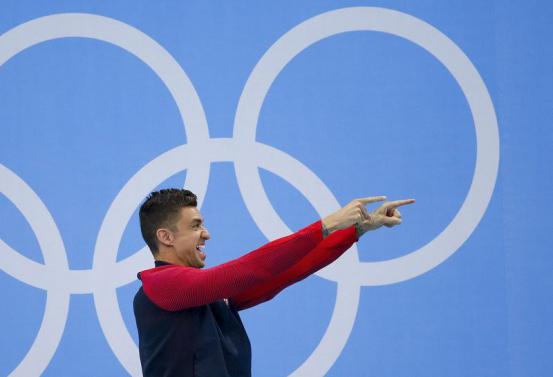
About a month removed from winning gold in the 50 freestyle at the Olympic Games in Rio de Janeiro, Anthony Ervin will celebrate the 16th anniversary of his first Olympic crown in the event next week. Because that celebration is around the corner, it seemed an appropriate time to look at his historic tie for the 2000 gold medal with teammate Gary Hall Jr.
Because Gary Hall Jr. saw him every day, was fully aware of his talent level and knew he was capable of beating anyone in the world, the veteran Olympian and sprint champion had plenty of respect for what Anthony Ervin brought to the starting blocks.
Because Anthony Ervin saw him every day, was fully aware of his yearning desire and knew he wanted individual Olympic gold more than anything else the sport could provide, the upstart sprinter had plenty of respect for what Gary Hall Jr. brought to the water.
Together, Hall and Ervin wrote one of the most intriguing chapters in Olympic history, when they tied for the gold medal in the 50 freestyle – the one-lap dash which determines the fastest man in water – at the 2000 Olympics in Sydney. The way they arrived at that point, however, was quite different and only added a level of depth to their tale.
As the 2000 United States Olympic Trials in Indianapolis approached, Hall was the best-known name of those contending for a berth on the American squad. Deeply talented, he was a star at the 1996 Olympics in Atlanta, where he anchored the United States to gold medals in the 400 freestyle relay and 400 medley relay, and won silver medals in the 50 freestyle and 100 freestyle behind Russian sprint legend Alexander Popov.
More, Hall hailed from a family with a rich swimming tradition. His grandfather, Charles Keating Jr., was an NCAA champion for the University of Cincinnati in the 1940s and his uncle, Charles Keating III, was a 1976 Olympian. It was Hall’s father, though, who had the greatest success in the pool until his son came along. A three-time Olympian from 1968-76, Gary Hall Sr. won a medal at each of his three Olympiads, claiming silver in the 400 individual medley in Mexico City (1968), silver in the 200 butterfly in Munich (1972) and bronze in the 100 butterfly in Montreal (1976).
His career was also defined by multiple national championships and world records in the 200 butterfly, 200 individual medley and 400 individual medley. Hall Jr., although a sprinter, simply continued the family tradition. As he made his way up the ranks, Hall was one of the most outspoken voices in the sport. He was not afraid to raise concerns over performance-enhancing drug use and he possessed a deep confidence which was viewed by some as showboating, namely his shadow-boxing routine behind the blocks prior to races. More than anything, Hall was letting his personality shine.
In 1999, though, Hall’s serious side came to the forefront. Following an incident in which he collapsed, Hall was diagnosed with Type 1 diabetes and doctors initially informed Hall that the diagnosis would put an end to his athletic career. Not satisfied with that outcome, Hall vowed to fight through his disease and managed to control his illness with proper attention and care.
As important, Hall became a visible figure in the fight against diabetes, regularly speaking about the positive and active lifestyle which can be enjoyed by those afflicted. He also took part in fundraising events and activities which gathered money toward research and diabetes care.
Gary Hall jr [Courtesy: ISHOF]
Hall was initially scared by the possible effects of diabetes, such as blindness or kidney failure.
“The diabetes was really a major factor in my life, not just my swimming career. The travel took something out of me. It affected my blood-sugar levels. But I paid attention to what I ate and made sure I got the right amount of insulin. It was so scary when I was diagnosed. I heard these horror stories and the statistics. My reaction was it’s just a matter of time. I’ve only got so much time before these things happen.
“But the quality of life a person with diabetes can have really comes down to the individual and the management that individual can provide. Other people have been able to successfully manage this disease and avoid very serious complications that stem from this disease, so it can be done. If there are complications, it’s difficult to blame anybody but yourself.”
While Hall was a well-established veteran, Ervin was a soaring youngster with the Sydney Games on the horizon. One of the nation’s top recruits coming out of high school, Ervin wasted little time making an impact upon his emergence at the University of California-Berkeley. During his freshman season, Ervin captured NCAA championships in the 50 freestyle and 100 freestyle, victories which quickly turned heads considering his precocious nature. Suddenly, Ervin was a legitimate contender to qualify for the United States squad bound for Sydney.
As much as Ervin’s talent captured the attention of the media, so did his upbringing. Born to an African-American father and Jewish mother, Ervin’s bi-racial background received headlines, primarily because the United States had never had an Olympic swimming medalist with black heritage. For his part, the introspective Ervin tried to shy away from that categorization.
“I have always been proud of my heritage,” he said. “But I don’t think of it in terms of first of this, first of that. It is like people are trying to pin it down to one definitive thing. I never thought about it. In the nature of American society today, I would think having diverse blood would not be a big deal.”
Their paths to Sydney different through the end of Ervin’s freshman year at Cal, Hall and Ervin came together in Phoenix, Arizona several months before the United States Olympic Trials. At the Phoenix Swim Club, sprint guru Mike Bottom – an assistant coach at Cal at the time – oversaw a talented collection of athletes, headlined by Hall, Ervin and Poland’s Bart Kizierowski, a world-class sprinter in his own right.
Training next to one another, Hall and Ervin now were following a similar blueprint. They took part in identical practices, constantly battled to get to the wall first and ate the same meals at the same restaurants. Aside from sharing Bottom as a coach, they also shared a sports psychologist and strength trainer.
The fact that Hall and Ervin trained together in pursuit of the same goal, and did so while maintaining and further growing a friendship, was not exactly the norm. While the Hall-Ervin combination worked in Phoenix, legendary coach Richard Quick was forced to alter his training approach in Northern California. With Jenny Thompson and Dara Torres both under Quick’s guidance, the Stanford …